
If your counters work fine but look like 1995, epoxy can put a new surface right over them. It’s a real option with real limits, and it’s worth knowing both before your kitchen is taped off.
What an epoxy countertop is
An epoxy countertop is a coating poured over your existing counter. The old surface gets sanded and primed, then a base color goes down, then a thick clear or tinted epoxy is poured over the top and spread so it runs over the edges. While it’s wet, the crew can work in veins, swirls or metallic pigment to make it look like marble, stone or something that doesn’t exist in nature.
When it cures, you have a hard, glossy, one-piece surface with no grout lines and no seams. It’s a coating, so it treats knives and hot pans the way a coating does, and it looks great when it’s done right. Read more on our epoxy countertop coatings page.
What it can go over
Epoxy can go over most solid, well attached counters. The thing underneath has to be sound, because the epoxy only stays as good as what it’s bonded to.
- Laminate in good shape, with no bubbling or loose edges
- Tile, once the grout lines are filled and sanded flat
- Older solid surface counters
- Granite or other stone you’re tired of looking at
What we’d tell you to replace instead
Some counters aren’t worth coating. If the laminate is peeling off the board, or the particle board underneath is swollen from water near the sink, the epoxy will look great for a while and then go wherever the substrate goes. Same with loose tiles or cracked counters that move when you lean on them.
In those cases Julio will tell you straight up. Fixing the base first, or replacing that section, beats pouring over a problem. We’d rather lose the job than sell you a counter that fails because of what’s under it.
The Lancaster counter
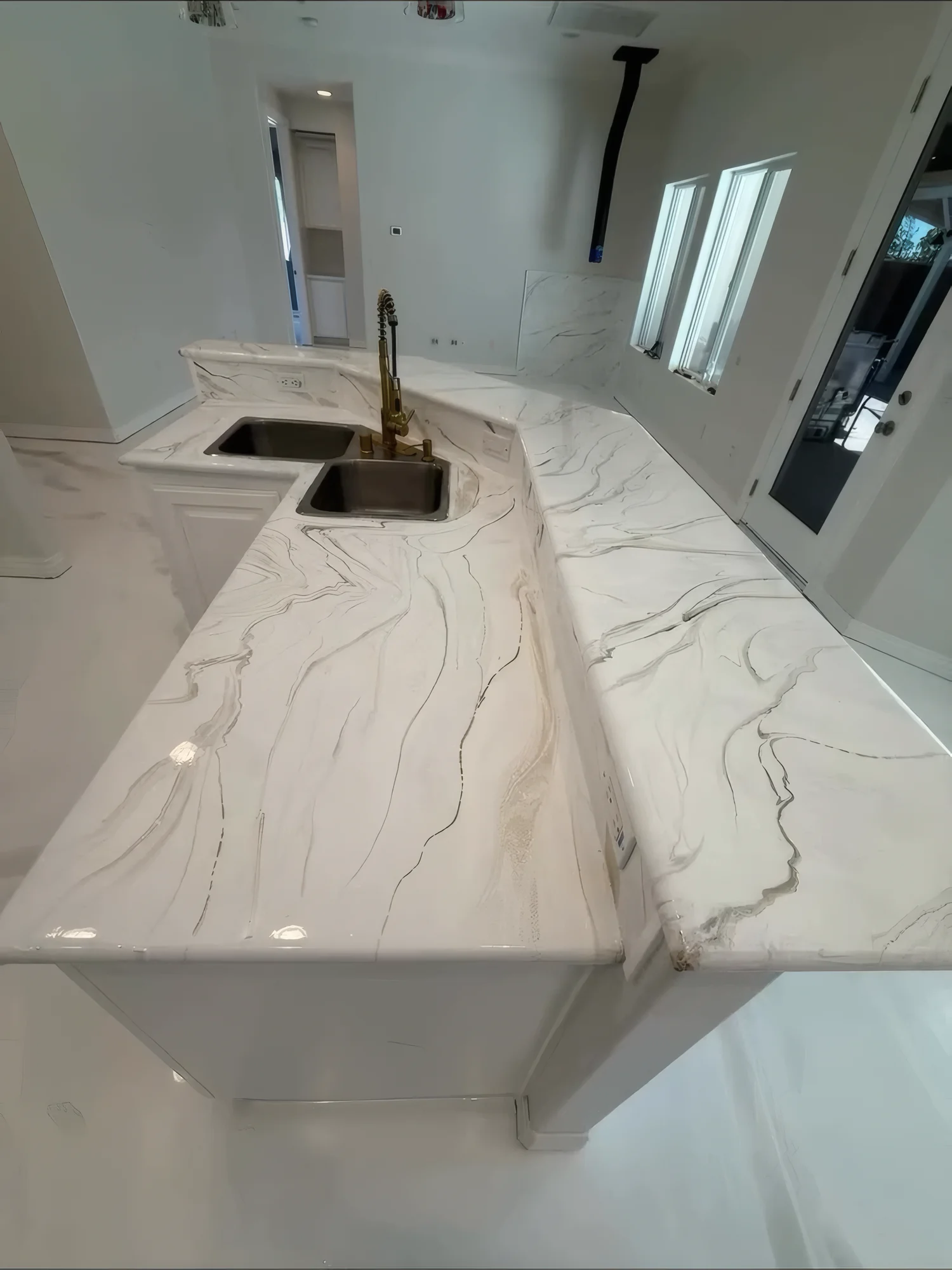
In a house in Lancaster we did a white marble-look epoxy countertop. That same house got a white pearl metallic floor through the kitchen and living room, so the counter and the floor were designed to sit together: white on white, with the marble veining on the counter and the pearl movement on the floor.
It’s a good example of how epoxy works in a kitchen. The counter reads as one clean slab with no seams, and the white makes the room brighter. A marble look is one of the most popular choices because it suits most kitchens and doesn’t fight the cabinets.
How the job runs
Most of the work is prep and protection. Epoxy runs, and it finds every gap, so the kitchen gets covered before anything is opened. A typical countertop job goes like this:
- Clear the counters and pull the sink fixtures if needed
- Cover the cabinets, floors and walls with plastic and tape
- Sand the old surface and clean it
- Fill seams, grout lines and chips, then sand flat
- Prime and lay down the base color
- Pour the epoxy, spread it over the edges, and work in the veining or design
- Catch the drips under the edges as it levels
- Let it cure before anything sits on it
How long the kitchen is down
Plan on not using the counters for a few days. The epoxy has to cure before it can take dishes, and longer before it’s ready for full use. Cure time depends on the product and the temperature in the house. Antelope Valley houses can swing warm and cool through the day, so we keep an eye on that.
It helps to set up a small temporary kitchen somewhere else: a table, the microwave, the coffee maker. Julio will tell you when you can set light things on the counter and when it’s ready for normal use, and we’d ask you to wait for the second one.
Living with an epoxy counter
Epoxy is hard and easy to wipe down, and it doesn’t soak up stains the way grout does. A few rules keep it looking right. Use a cutting board, always, because knives will scratch it. Use trivets for anything hot off the stove or out of the oven, since a hot pan can leave a mark. Wipe it with mild soap and water. Skip abrasive scrubbers and harsh cleaners that can dull the gloss.
Sun matters indoors too. A counter right under a bright window can shift color over time with some products, so Julio will look at the light in your kitchen when he picks the system.
Questions
Can you put epoxy over my tile countertop?
Usually, yes. The grout lines get filled and sanded flat first so they don’t show through. The tiles have to be solidly attached, because a loose tile will crack the epoxy over it.
Is an epoxy countertop heat proof?
No. Hot pans straight off the stove can mark it, so use trivets. Normal warm plates and mugs are fine.
Does the kitchen smell during the job?
There’s some smell while the epoxy is being mixed and poured, and it fades as it cures. We keep the space ventilated. If anyone in the house is sensitive to smells, tell Julio and we’ll plan around it.
Can you match an epoxy floor to the countertop?
Yes. In the Lancaster house we did a white marble-look counter and a white pearl metallic floor in the same space. Julio can help you pick colors that work together.
Julio looks at the countertop before anything gets quoted. Call or text (818) 698-5011, email Supremeepoxyboyz26@gmail.com, or see the gallery first.