
You park after a long summer drive, back out the next morning, and there’s a bare patch of concrete where the coating used to be. That’s hot tire pickup, and the high desert is hard on floors that aren’t built for it.
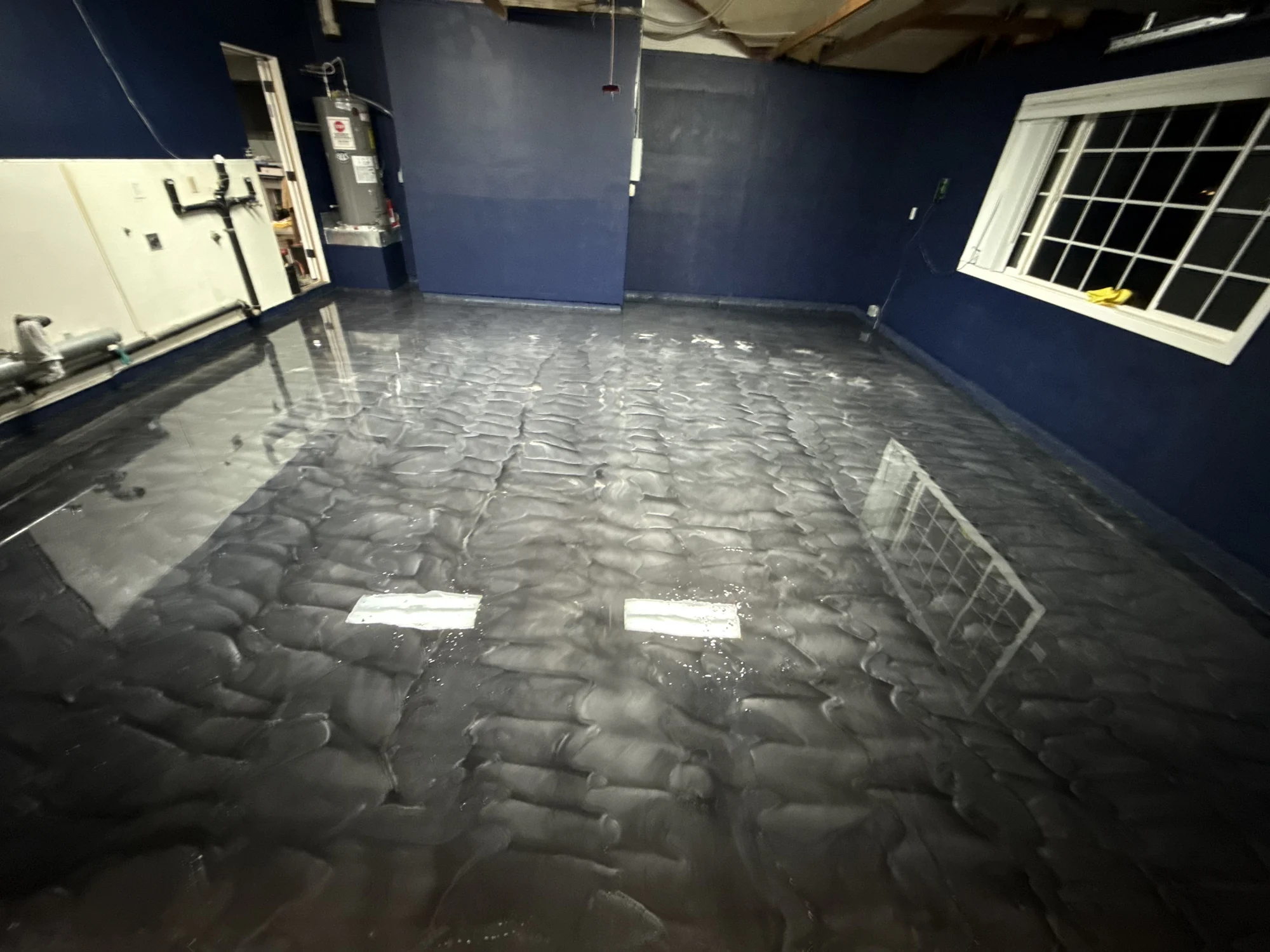
What it looks like
Hot tire pickup usually shows up in the tire paths first. Sometimes it’s a dull, tire-shaped print that won’t wipe off. Sometimes the coating lifts in a patch the size of the tread. Worst case, it peels in sheets and you can see the gray slab underneath, sometimes with coating still stuck to the tire.
Once it starts, it spreads. The edge of a lifted patch is a weak spot, and the next hot tire grabs it again. That’s why a floor can look fine for a year and then fall apart in one summer.
Know the difference between a print and a peel. A light print on a good floor can sometimes clean up with the right cleaner, and it’s mostly cosmetic. A peel means the coating let go of the slab, and that points back to how the floor was built.
Why the Antelope Valley makes it worse
Tires heat up while you drive, and the longer and hotter the drive, the hotter they get. A lot of people out here commute down the 14 into the valley and back, in summer air that’s already well into the hundreds some afternoons. Then the car pulls into a garage that’s been cooking all day.
A hot tire is soft and sticky, and it presses down on the floor while it cools. The rubber has chemicals in it that soften as it heats, and some of those can move into a weak coating. When the tire cools, it grips that softened spot, and when you drive off, it pulls.
Then there’s the night. High desert nights get cold, and the floor shrinks and swells with those swings. A coating that’s barely holding on gets worked loose a little more every day.
The usual causes
Tires don’t pull good floors apart. They find the weak ones. When a garage coating peels from hot tires, it nearly always traces back to one of these:
- Bad prep: an acid etched or barely cleaned slab, so the coating never bonded to sound concrete
- Too thin: one or two light coats from a kit, with nothing to absorb the heat and stress
- Wrong product: water-based garage paint or a cheap epoxy that softens in heat
- Parked on too soon, before the coating had fully cured
- Oil left in the slab under the coating, slowly breaking the bond from below
Kits and the first summer
Kits are the most common version of all this. The box shows a shiny garage, the instructions say etch, roll and wait a day, and the coat that goes down is thin. It can look fine through winter, and the first long summer usually ends it. We get why people try them. Just know what you’re buying.
When Julio comes out to a floor that’s already peeling, he looks at the back of the pieces that came up. Bare coating with no concrete stuck to it usually means the bond failed, which points at prep. Concrete stuck to the back means the coating held and the top of the slab gave way, which points at a weak surface that should have been ground off. A thin, rubbery feel points at the product. Each one changes the fix, so he’ll tell you what he sees before he talks about price.
How we build a floor that holds
Our answer starts under the coating. Every slab gets diamond ground so the base coat soaks into rough, clean concrete. Cracks get filled. Oil spots get worked on until the concrete will take a coating. That bond is what keeps the floor down when a tire pulls on it.
Then thickness. On a flake floor, the base coat is fully loaded with chips and then sealed with a clear top coat, which builds a real layer over the slab instead of a skin. On a metallic, the pigmented coat goes on thick enough to move around and still carry a top coat over it.
The top coat is where the tires touch, so we pick it for heat and sun. On most garages that means a polyaspartic top coat, which holds up to UV and stays hard. More on that on our polyaspartic floor coatings page, and you can see the full system on our garage floor epoxy page.
Cure time is part of the floor
A coating can feel hard to the touch long before it’s ready for a car. Walk on it, sure. Park a hot car on it too early and you can leave prints that never come out.
Cure depends on the product and the temperature. Hot garages speed some products up. Cold winter nights slow them down. Julio will tell you when the floor is ready for foot traffic and when it’s ready for the car, and we’d ask you to actually wait. It’s one more day of parking in the driveway against a floor that’s ruined from week one.
Habits that help a good floor
A floor built right handles hot tires without help. A few small things keep it looking better longer. Sweep or dust mop sand out of the tire paths, since grit under a hot tire wears the top coat. Wipe oil and coolant drips when you see them. Put pads under jack stands and kickstands so the weight doesn’t dig into one small spot.
If something does lift, call early. A small spot caught the week it starts is a much smaller fix than a whole tire lane that’s been peeling all summer.
Questions
Can you fix a floor that already peeled from hot tires?
Usually, but the old coating has to come off first. Patching over a failed coating just gives the tires a new edge to grab. We grind or remove what’s there, then build the floor back up properly.
Do tire mats stop hot tire pickup?
They can keep tires off the floor, but they also trap sand and moisture underneath. A properly built coating doesn’t need them. If you like them, lift and clean under them often.
Is metallic or flake better against hot tires?
Both hold up when the prep, thickness and top coat are right. Flake tends to hide light tire marks better because of the speckle. Metallic shows more of what’s sitting on it.
Is hot tire pickup covered by your warranty?
Our flake and metallic floors carry a one-year workmanship warranty. If the coating lifts because of how we installed it, that’s on us and we come back. Julio will go over what’s covered before the job starts.
Julio looks at the floor before anything gets quoted. Call or text (818) 698-5011, email Supremeepoxyboyz26@gmail.com, or see the gallery first.