The top coat is the layer your tires, shoes and the high desert sun actually touch. Pick the wrong one and a gray floor turns a little yellow, a white one turns cream, and nobody can undo it.
The top coat takes the hits
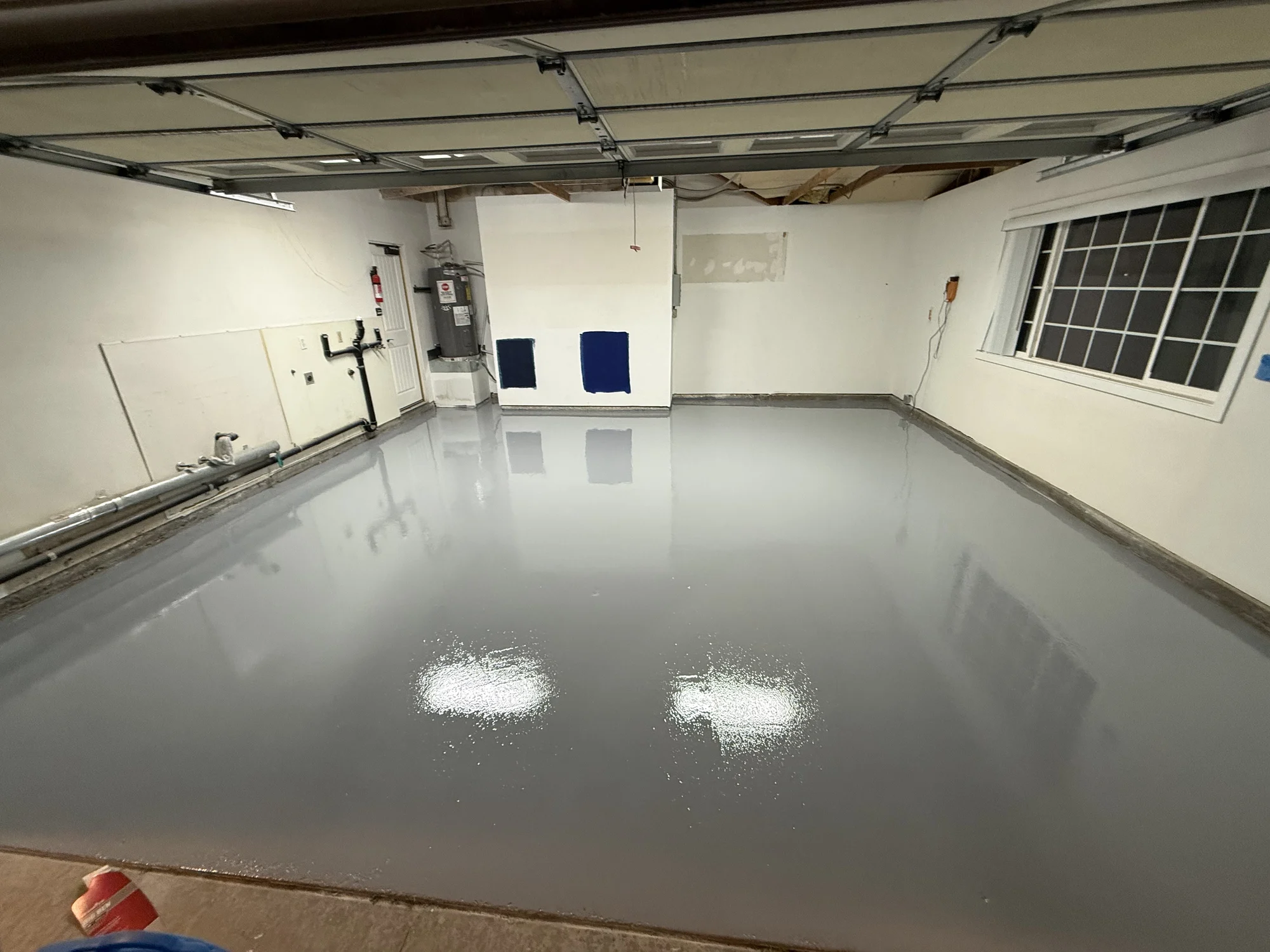
Most of what people pick when they choose a floor is underneath: the color of the base, the flake blend, the metallic pigment. The top coat is clear, so it’s easy to treat as an afterthought. It shouldn’t be. It’s the layer that gets scuffed, scraped, rolled over and baked.
In the Antelope Valley, it also gets sun. A lot of garages here have the big door open for hours, facing straight into afternoon light. Shops with big roll-up doors see even more. UV is what separates top coats faster than anything else up here.
What sun does to regular epoxy
Standard epoxy is a great base. It soaks into ground concrete, bonds hard and builds thickness. What it doesn’t like is UV. Most epoxies amber over time in sunlight, which means they slowly pick up a yellow tint.
On a dark flake floor you might barely notice. On a white, light gray or pale metallic floor, it shows. And it doesn’t happen evenly. The strip of floor right inside the garage door, where the sun hits, can turn while the back of the garage stays the original color. That two-tone look is hard to fix without recoating.
Epoxy also scratches more easily than a good top coat, and it can soften a bit in high heat. Neither is a dealbreaker underneath. Both matter on the surface.
Some epoxies carry UV blockers and do better than others, so the yellowing varies by product. Even the better ones don’t match a UV stable top coat in a garage that gets real sun.
What polyaspartic does differently
Polyaspartic is a different chemistry, related to polyurea. The big thing for us is that it’s UV stable. It stays clear in sun instead of yellowing, so the color you picked stays the color you picked. It’s also hard and handles scratches and hot tires well.
It cures fast, which is mostly good news: less downtime, and less time for wind-blown dust to settle into a wet coat. The catch is that it gives the crew a short working window once it’s mixed. It has to be rolled out quickly and evenly, and it can’t be fussed with. That takes practice, and it’s one reason kit installs struggle with it. See our polyaspartic floor coatings page for more.
Fast cure and desert wind
The fast cure has one more upside out here. A slow coating sits wet for hours, and on a windy Antelope Valley day, dust and sand find their way under the garage door and onto anything sticky. Every grain that lands in a wet coat stays there for good. A polyaspartic top coat skins over quickly, so there’s less time for that.
We still close everything up and watch the forecast when we schedule a top coat. On a day when the dust is really blowing, we’d rather move the top coat a day than trap half the desert in your floor.
Where epoxy still belongs
Epoxy still does most of the work on our floors. It’s what we use underneath on most floors: the base coat that grabs the slab, the coat that holds the flake, the pigmented coat on a metallic epoxy floor. It builds body and bonds well, and none of that layer sees the sun once a top coat covers it.
Indoors, away from sunlight, an epoxy top coat can be a fine choice too. A shop with no windows, a basement area, a back room. If UV never reaches the floor, yellowing isn’t the problem it is in a garage with a west-facing door.
How we usually stack a garage
Julio will ask which way the garage faces, how long the door stays open, and whether you work in there with it up. Those answers point us at the top coat more than anything else.
On a metallic floor the idea is the same. The pigment lives in the epoxy coat, and the polyaspartic goes over it to keep the color and shine from fading near the garage door. It’s the part nobody sees, and it’s the part that keeps a light metallic looking like the day it went down.
Every floor is different, but a typical sunny Antelope Valley garage from us goes together like this:
- Diamond grind and vacuum the slab
- Crack and chip repair
- Epoxy base coat, tinted for the system
- Flake broadcast, or for metallic, the pigmented epoxy coat worked by hand
- Polyaspartic clear top coat, sometimes with grit added for traction
Solid colors and the sun
Solid color floors show the difference between top coats more than any other. There’s no flake or swirl to hide a shift in color, so if a light solid gray floor starts to amber, you’ll see it. For a solid floor in a garage that gets sun, we’d lean hard toward a polyaspartic top coat, and Julio will tell you that up front.
If you’re comparing quotes, look at what the top coat is. Two floors with the same color chips can look very different after two summers depending on that one line. Read more about full systems on our garage floor epoxy page, or have Julio come look at the floor and tell you which way he’d go.
Questions
Will a polyaspartic top coat ever yellow?
Polyaspartic is UV stable, so it holds its color far better than standard epoxy in sun. Like any floor, it can get scuffed and dull with heavy use and grit. Regular sweeping keeps it looking right.
Can you put polyaspartic over my existing epoxy floor?
Sometimes, if the old floor is well bonded and only the surface is tired. It has to be sanded and cleaned so the new coat grabs. If the old coating is peeling, it needs to come off first.
Is polyaspartic more slippery?
A smooth clear coat of any kind can be slick when wet. We can mix a fine grit into the top coat for grip. On flake floors, the chip texture helps too.
Does cold weather affect polyaspartic?
Cold slows most coatings down, and Antelope Valley winter nights get cold. We watch the temperature of the slab and the air before we mix anything. Julio will plan the job around the weather.
Julio looks at the floor before anything gets quoted. Call or text (818) 698-5011, email Supremeepoxyboyz26@gmail.com, or see the gallery first.