
A metallic floor looks like poured metal or marble, and people assume it’s one magic coat. It’s four or five layers, each one with a job, and the swirl you see on top only works because of what’s under it.
Why metallics look the way they do
The look comes from metallic powder, tiny flat flakes of pearl or mica, mixed into a clear or tinted epoxy. While the epoxy is wet, those flakes can turn and drift. Where they lie flat, they catch the light and shine. Where they tilt or bunch up, they go darker. The crew pushes the wet coat around on purpose so the flakes settle into swirls, veins, clouds and ripples.
That’s why no two metallic floors come out the same, even with the same colors. It’s also why the layers underneath matter so much. A metallic is a thin, glossy, show-everything finish. Every bump in the slab, every unfilled crack and every speck of dust under it shows through. Here’s what goes in, from the concrete up.
Layer one: the grind
Every metallic starts with a diamond grinder on bare concrete. It takes off the weak top skin of the slab, old sealer, paint and stains, and leaves a rough, even surface the first coat can soak into. Edges and corners get a hand grinder, since the big machine can’t reach them.
Grinding for a metallic is a little more careful than for flake. Flake chips cover small flaws. A metallic doesn’t. High spots and ridges get ground down so they don’t telegraph through the finish, and the whole floor gets vacuumed twice before anything is mixed. More on the grind on our concrete grinding page.
Layer two: repairs and the base coat
Cracks get opened and filled, and chips and pits get patched, with material made to sit under a coating. On a metallic these repairs get sanded flat, because a filled crack that sits a hair proud of the floor will show as a line.
Then the base coat. This is a pigmented epoxy rolled over the whole slab. It seals the concrete so air in the slab doesn’t bubble up into the metallic coat, and it sets the background color. The base color changes the whole floor. A black base under a copper metallic makes the copper pop and gives the darks real depth. A white base under pearl keeps everything bright and soft.
Layer three: the metallic coat
This is the layer people watch. The metallic epoxy gets mixed and poured out in sections, then spread to an even thickness. While it’s still wet, the crew works it. Rollers, brushes, a spray of solvent, air, and sometimes just the way you walk through it in spiked shoes all move the pigment differently. Some designs use two or three metallic colors poured side by side and blended at the edges.
There’s a time limit. Once the epoxy starts to set, the pigment stops moving and whatever you have is the floor. So the crew plans the design before mixing, works in a steady order across the room, and doesn’t stop to second-guess. A good metallic looks loose and natural. Getting it there is anything but loose.
This coat also needs calm air. Wind-blown dust landing in a wet metallic stays in it, so on an Antelope Valley job we close doors and watch the forecast before we pour.
Layer four: the top coat
Once the metallic coat cures, a clear top coat goes over it. This is what takes the foot traffic, chair legs and car tires, and it’s what keeps the shine. In a garage or any room that gets sun, we lean toward a polyaspartic top coat because it holds up to UV and stays clear instead of yellowing. Indoors, away from windows, there are more options.
The top coat is also where traction gets decided. A smooth gloss looks amazing and gets slick when wet. A fine grit mixed into the top coat gives shoes some bite with only a small hit to the shine.
Two floors we’ve done
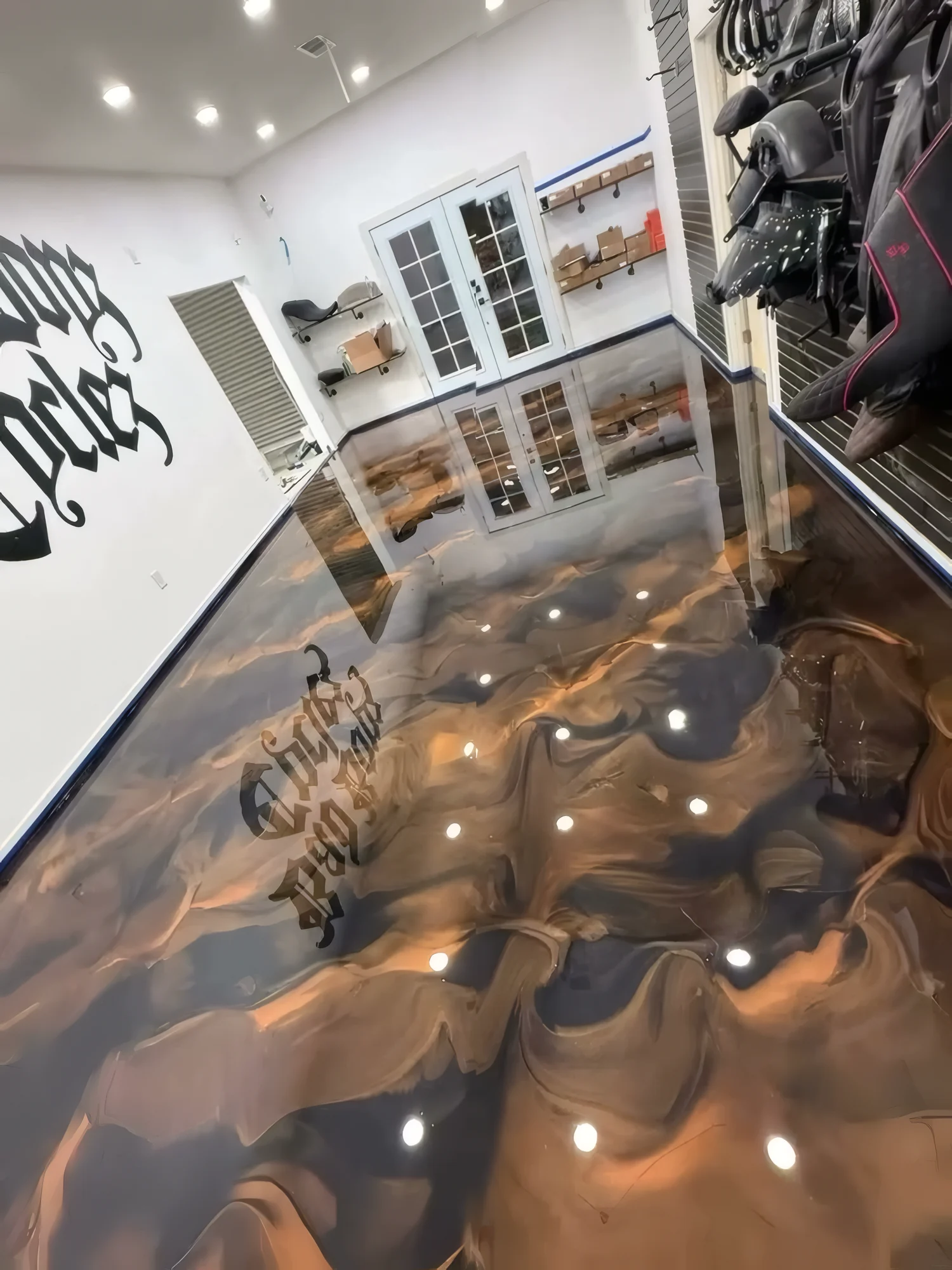
At Bad Boyz Cyclez, a motorcycle shop showroom in Sun Valley, we put down a black base coat, then a copper-and-black metallic floor over it. That’s the dark base doing its job: the copper swirls stand out hard against the black, and the floor looks right under bikes.
In a house in Lancaster we went the other direction: a white pearl metallic floor through the kitchen and living room. Same layers, completely different feel. Light, soft and bright instead of dark and dramatic. We also did a white marble-look epoxy countertop in that house. Both floors used the same steps in the same order. The colors and the way the crew moved the pigment made them look nothing alike. See more on our metallic epoxy flooring page.
What can go wrong, honestly
Metallics are less forgiving than flake, so it’s worth knowing the risks before you choose one.
- Roller or tool marks if the metallic coat is worked too late
- Dust and bugs landing in the wet coat on a windy day
- Slab flaws showing through when the grind and repairs were rushed
- Bubbles or pinholes when air comes up out of unsealed concrete
- A floor that doesn’t match what you pictured, because the pigment moves by hand
Questions
Can I see exactly what my metallic floor will look like before you pour it?
You can pick colors and a style, and Julio can show you how those colors behave. The exact pattern only shows up as the crew works the wet coat. If you need to know every detail ahead of time, flake is the better floor for you.
Do metallic floors work inside the house, not only in garages?
Yes. The Lancaster pearl floor runs through a kitchen and living room. The slab still has to be ground and repaired the same way, so we look at what’s on it now, like tile or old flooring, before we quote.
How long does a metallic floor take?
Usually a few days of work because each layer has to cure before the next goes on. Cure times depend on the products and the temperature. Julio will lay out the schedule after he looks at the slab.
Is there a warranty on metallic floors?
Yes, metallic floors carry a one-year workmanship warranty. If the floor fails because of how we installed it, we come back and fix it. Julio will walk you through it before the job starts.
Julio looks at the floor before anything gets quoted. Call or text (818) 698-5011, email Supremeepoxyboyz26@gmail.com, or see the gallery first.